Monthly Archives: September 2006

Some pictures


You know how I said I was going to pull out all my to-be-read books and put them on separate shelves? Well, here they are. It doesn’t look like that many, but it would take me about a year to read them all. At least.

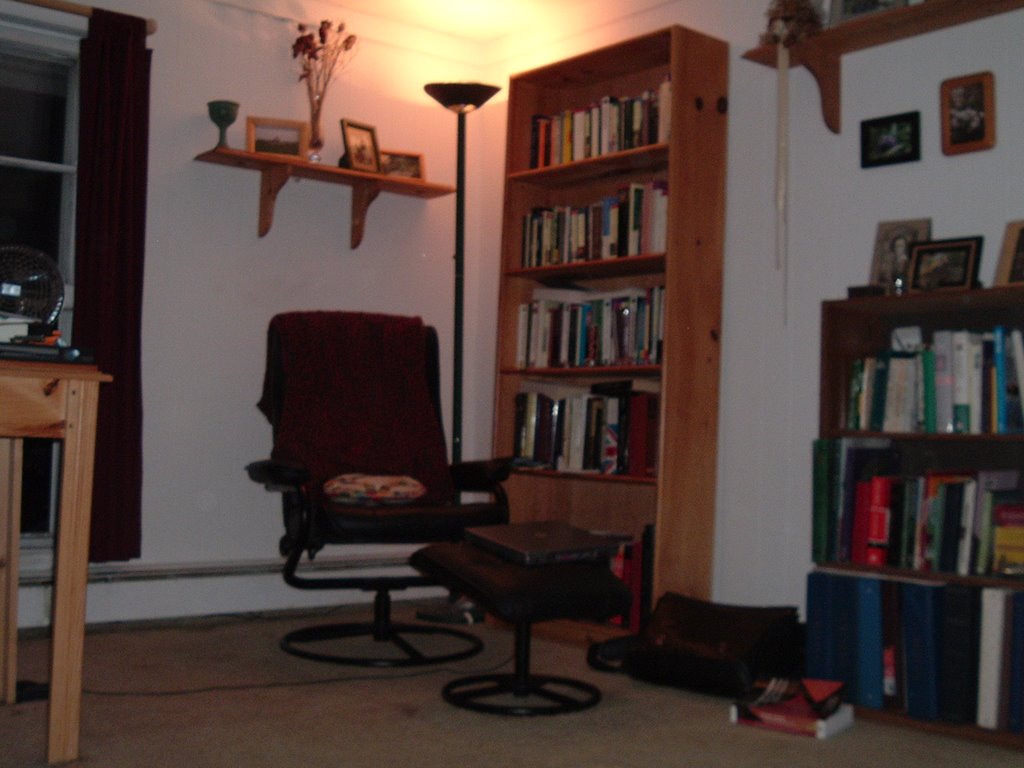
And if you are at all interested in where it is I do most of my reading, here’s a picture. It’s where I do my blogging too; you can see my laptop on the footrest.

Leave a comment

Filed under Books, Life

Swann’s Way

So I’ve now finished the first volume of Proust’s novel (and I’m counting each volume as a separate book!). It’s taken me about two months to read the entire thing; I’ve been reading in small chunks of about 10 pages or so, and read about 50 pages a week. For me, that’s the perfect way to read it; regularly enough to keep the story and ideas fresh in my mind, but at a slow enough pace to absorb it and to keep from feeling bogged down. This is most definitely not a book to rush.

And I’ve found it so very rewarding. Proust’s sentences are beautiful, long and digressive and convoluted, but they do yield their meaning, even if I have to read them a couple of times and turn the pages back and forth and back and forth to piece everything together. The book has sections that read quickly as well, particularly in the long middle section that tells the story of Swann and Odette. Here I found myself getting caught up in the story and the pages flew by. But best of all are Proust’s insights into consciousness, into what it’s like to be a young boy, for example, a very intense, intelligent, yearning young boy. We see him as both a little ridiculous – one of the things I liked was how I could imagine exactly why his parents found him exasperating – and as completely sympathetic and awe-inspiring and wonderful. His longing for his mother, and later for Gilberte, is moving; we know that such an intense, emotional child is bound to experience much struggle and pain.

This volume does have a carefully-wrought structure, although one entirely of Proust’s own devising; we begin with the unnamed narrator and a story of longing, and we end with that same narrator, a little older, longing still. All through the novel, Proust explores the way the mind mediates our experiences, shaping them through memory or desire; he considers how art affects his characters – the crucial role music and painting play in Swann’s love affair with Odette, for example. The novel is very much about reading; we learn a little about the narrator’s reading habits and desires in the first section, but also characters attempt to read one another, Swann desperately trying to understand Odette, the narrator reading much into everything his mother says, and then at the end turning the same attention toward Gilberte. The book trains readers to pay close attention, to their own minds and to other people and to the world. It contains some of most beautiful, detailed descriptions of nature I’ve read.

And the novel’s length strikes me as necessary, and not only because Proust needs the length to say what he wants to say about his characters and his ideas; there is something about living with this book for a long time, in much the same way that in reading Clarissa we come to feel like she is a companion, that we live with her, that we know her and she is a part of our lives. In Proust, we spend many, many hours luxuriating in the complexity of the mind and of emotion. We are forced – if we read carefully – to experience things slowly and to pay attention, to dig deeply into life.

And the way the narrative moves around in time, from the narrator as an older man describing himself as he is now, to the narrator telling stories from his childhood, to the narrator telling Swann’s story which took place before he was born, forces us to consider how our experience of time differs from “regular” clock time. In our minds, we move through time, back and forth, from past to present to future, easily and quickly. Proust’s central theme is memory, that capacity that holds us together and gives us a coherent identity. Except that our memories are not ours to control. A coherent identity may be an illusion, one fostered by memory, our ability to hold together disparate chunks of time, and undermined by memory too, since we can remember and forget involuntarily.

I’m looking forward to the other volumes; I’m curious about what Proust does with plot, oddly enough, perhaps. What will happen to these characters? Or will we even stay with these characters, or move on to others? But most of all, I’m looking forward to the company of Proust’s prose and his mind.

Leave a comment

Filed under Books, Fiction

Thoughts on books

With that generic post title, I can write about anything! I’m finding myself with a whole lot of little ideas on what to write here and can’t decide what to focus on, so I’ll write a little about a lot of stuff.

First of all, while I won’t tell you you must read Alison Lurie because I don’t believe in telling people they have to read things (um … unless you’re a student in my class that is — in that case, there’ll be a quiz), I think it would be great if more people read her. I finished The War Between the Tates last night and loved it. It’s smart, extremely well-written, clever and satirical, but also warm in a way many satirical novels are not. I like reading academic satires now and then, and this book would certainly qualify as one, but I do sometimes find them rather cold and brittle. Give me some emotional warmth, and I’m happy, and I found it here.

I’ve discovered a number of writers recently whom I’ve come to love — writers that are new to me, although not necessarily to others — and I’m interested that they are women: Rebecca West, Colette, Alison Lurie, Elizabeth Taylor, maybe Anne Tyler (I liked her latest book a lot, but I’m not sure I’m inspired to go read more). I’ve sensed that when I think of “great” writers of recent times, let’s say the last 100 years, I tend to think of more male writers than female; maybe I’ve picked up biases from the educational systems I’ve gone through, or maybe it’s that male authors are written about and reviewed more often than female writers. Well, I know the latter is true; maybe, my point is, I’ve picked up a bias from the media as well as from my education. And now I’m poised to read Margaret Atwood for the first time (Alias Grace, although Dracula will come first), so maybe I’ll find another woman writer to love. And the poets — yes — I’d add Jane Kenyon, Jane Hirschfield, and Mary Oliver to my list of recently-discovered women writers whom I’ve come to love. The friend of mind who loves Anita Brookner was wondering why she hadn’t heard of Brookner before, and surely it has something to do with the lack of serious attention paid to women writers — still.

But at any rate — Alias Grace just arrived in the mail through Book Mooch, and I’ve got a rather embarrassingly large number of books still to come. I’ve sent out two books to people, and have received two and am waiting on five more. I’ve accumulated points (which is what you use to request books from others) by adding books to my Book Mooch list (1/10 of a point for each book), and by mailing a book to Canada, which earned me a whole three points instead of the usual one. I justify my greed by reminding myself that people like to get books mooched from them because they can get rid of what they don’t want and use the points they earn to get ones they do. I eagerly await emails from people saying they want books of mine. So I tell myself I’m making people happy when I ask them to mail me books. It’s true, I’m sure!

So here’s what I’m waiting on: Ishiguro’s Never Let Me Go, Marguerite Navarre’s The Heptameron (in the style of The Decameron but written by a woman), Mythologies by Roland Barthes (this one I can justify because the Hobgoblin wants it), Nicholson Baker’s The Mezzanine (I like this guy a lot, and I’m not entirely sure why), and John Kelly’s The Great Mortality, the book on the plague. I’m not sure why a book on the plague fascinates me so much, but it does.

And I finished the first volume of Proust. I loved it. I’ll have to write more on it later — that surely deserves its own post, not a brief mention in this random one.

One other thing: I’m considering moving my to-be-read books to their own separate shelf, something I’ve never done before. I’ve got some space on my bookshelves upstairs in my study where I do most of my reading that would work nicely. This would please and appease my obsessive, hyper-organized self (another way to sort things!), and it would have another benefit: I’ll put the books on the shelf across the room from me, which, since it’s not a very big room, I’ll be able to see quite clearly. That way, the books I own that I haven’t read will be before me at all times, tempting me (hopefully) to read them next instead of rushing off to the bookstore to buy more books.

Leave a comment

Filed under Books, Reading

Colette and athleticism


One of the things that intrigues me about Colette is her interest in exercise and athleticism; I’m trying to figure out as I read her biography to what extent she’s pioneer in this way. I don’t know all that much about the history of women and athleticism, and I’d love to find out more. Here’s what Colette’s biographer says about it:

Colette was not the first woman of the century to work out, but she was one of the first amateurs. She had just turned thirty, and she had a morbid fear of succombing to the matronly flaccidity that was the fate of the average middle-aged woman of that era. In the process of becoming fit, she discovered that exercise strengthens one’s morale. “O molle ardeur de la femme amoureuse” — O mushy ardor of the woman in love! — she exclaims. In the gym, she was battling that mollesse, and acquiring a “modern” body: hard, supple, and, from the perspective of her era, androgynous. She was also, consciously or not, training herself for the profession she would take up when her marriage ended. Colette had understood, precociously, that the true beauty of a woman’s muscles is identical with their purpose, and that’s self-support.


It’s interesting (and probably typical) the way Colette seems to combine admirable and questionable motives for working out: she does it to conform to a cultural image of beauty but also to begin to become independent. I like very much what Thurman says about the beauty of a woman’s muscles being about self-support.

Here’s another passage, this one about the dancer Isadora Duncan:

Despite the pride and pleasure she took in her discipline [exercise], Colette wasn’t deluded about the extent to which a contemporary woman might throw off her fetters … she writes of [Duncan’s] “naive person,” and what was specifically naive to Colette was the idealism of her message. It didn’t escape her that the women who had come to cheer this “little naked creature in her veils” were corseted from their armpits to their knees, absurdly hatted, slaves to fashion, “heroic and bound.” “I muse on how peculiar women are, watching all these ladies who applaud Isadora Duncan … let us not fool ourselves! They acclaim her but they don’t envy her. They salute her at a distance, and they contemplate her, but as an escapee — not as a liberator.”

If Colette dreamed of escape, she never underestimated the difficulties posed to women by their desire to remain bound. “Reflecting on it later, it has seemed to me that I was exercising my body in the way that those prisoners who aren’t concretely planning a breakout still braid a sheet, sew gold pieces into a lining, and hide chocolate under their mattresses.” Colette’s gymnastics were flexing a will that aspired to, but wasn’t yet fit for, the rigors of freedom.


So in Colette’s time and place, strong athletic women like Duncan were admired but not emulated. This makes Colette’s own physical ambitions that much more interesting — she would be someone who would both admire and emulate, gaining strength and turning into a performer herself later on. I like the way she is practicing freedom from the constraints of the patriarchy, even though she can’t escape them yet, through physical exertion.

Leave a comment

Filed under Books

Books, bikes, and numbers

I’m interested in the ways people keep track of their reading, or don’t; in the comments to yesterday’s post, people said some interesting things about the benefits and drawbacks of lists. Yesterday I mentioned the range of books I’ll probably end up reading this year, but the truth is, this is the first year I’ve kept track of my reading, so I have no idea how representative my number of 50-60 books is of my typical reading pattern. And it’s reading blogs that gave me the idea; seeing the lists of books read in people’s sidebars made me want a list of my own. That, and I don’t always remember accurately how long ago I read something, and now I have a way of checking.

This is the good thing for me about lists — to jog my memory — and it’s a good thing about the blog itself, where not only can I look up what I read, but what I thought about it. I wish I had a better memory, but I’m better off acknowledging I don’t, and therefore keeping a good record.

But the bad thing about list-making and book-counting is that it feeds my obsessive, number-crunching, year-to-year comparing, self-critical, and worried-about-stupid-things-all-the-time side. I’d like to think that it doesn’t matter how many books I read in a year or how long it takes me to read them, or how many pages I can read an hour. Actually, I do think it doesn’t matter — what matters is what I make of my reading and how much pleasure I get from it. I really do believe that. Well, one part of me does, the sensible, reasonable part. But the other part of me, equally strong, does care about numbers and loves making comparisons and would wonder why, if one year I read 60 books, another year I’d only read 40. When this side of me speaks, it says “keep track!” When my sensible, reasonable side speaks, it says “don’t!” So which side of me will win out? Probably the number-cruncher side. The blog, in spite of all its wonderful qualities, does encourage the number-crunching side of me. It makes it so much easier to keep lists and count books. And I do like math. I like numbers and statistics. I find them fun.

Bettybetty wanted to know if this worry about reading speed is a carry-over from cycling. In one sense, no; I’m not really worried about my reading speed; I can accept my slow pace with a book when I’m less likely to accept it on the bike. But in another sense, the interest in numbers is similar in both areas. There is so much I can count with my bike computer/heart rate monitor: miles ridden on each ride, miles ridden this month, miles ridden this year, average speed, maximum speed, average heart rate, maximum heart rate, average cadence, maximum cadence, calories burned, time spent in target heart rate zones, etc. etc. I’m sure I’m forgetting something. I discovered a website this year where I can keep track of these things: Bike Journal. Here, I can enter all my information, and it’ll keep track of it and add up my monthly and yearly numbers.

This is a wonderful thing. But it’s all about codifying an experience that is wonderful for all sorts of non-codified ways. Numbers are great for serious training, so there’s no way I’m giving them up, but I can get too obsessed with them, and wonder, for example, why I rode slower today than yesterday. Why is my average speed in August slower than it was in July? Ugh. It’s impossible, thank God, to keep stats about reading in the same way I keep them about riding, but the counting impulse is still there.

Somehow I have to find a way to balance my sometimes unbalanced self.

Leave a comment

Filed under Books, Cycling, Reading

Reading time

Do you consider yourself a slow or a fast reader? I’d call myself a slow one. Obviously, such things are relative, but I’ve found that the Hobgoblin not only reads more books over the course of a year than I do, but that he seems to be able to get to the bottom of the page faster during those few times we’ve shared a magazine or newspaper. And I read book bloggers who seem to get through books awfully quickly, posting book reviews with admirable frequency. I think I’m slow in terms of the speed with which I process words and sentences, and if I read a decent number of books a year — this year I’ll probably read between 50 and 60 — it’s because I have a lot of time for reading, or, rather, I make a lot of time. The Hobgoblin and I just had a conversation about the things we could do if we didn’t read so much — things like keeping the house clean, the lawn neat, the pool free from algae (or, better yet, we’d have time to get rid of the stupid thing and do something better with the yard) — a list which is not particularly inspiring. We’ll continue to opt for the reading time.

I’m in awe of those who can regularly read a book in a day or two, who can sit down for a couple of hours and get through hundreds of pages. I must have read a book in a day at some point in my life, but I can’t remember when, and the book must have been quite short. I can read things fast if I make myself — student papers are one example of reading material I’ll rip through, eager to get to the end — but generally I’m happy to linger over words and sentences, re-read things, pause frequently and look up to consider a point, and let my mind wander.

Even more significant for me, though, is that I can’t seem to take in that much of a story in one sitting before I begin to get a bit anxious, feeling like I need a break. I need a lot of time to process what I’m reading, I think. If I read too much of a novel in one day, say more than 70-80 pages, or even less, depending on the novel, I feel as though I’m not really appreciating it, not really absorbing it. It’s like I can only comprehend a certain amount of action or information, or a certain number of plot events or character revelations before I begin to feel overloaded. And with nonfiction, it’s even worse — if I’m reading something full of facts and ideas I’d like to remember, I need even more time to process it — to think about it and make sense of it before I go on to the next thing.

Reading multiple books helps me with this problem — if it is a problem; if I feel like I’ve read enough of Proust, I can turn to my biography of Colette, or my book of poetry, or whatever else, and I won’t feel overwhelmed. I think this has less to do with the total number of hours of reading in a day than with the amount of any one book I can take in at a time, although I can’t hop from book to book for all that terribly long either — I’ll get restless.

So — while I’d love to be able to read more books than I do, I’d really, really love it, I’m not sure I could, even if I had more hours available in the day. I’d lose something by trying to cram too much in. I think that if I tried to read more than, say, 60 books a year, I’d have to force myself to read less well. I love the idea of days and weeks with not much else to do but read (and ride my bike), but the reality is that I’d be unhappy. So I’m just going to have to pretend that I will have an unlimited number of years to read what I want to read, and therefore that my slow pace doesn’t matter.

Leave a comment

Filed under Books, Reading

Alison Lurie’s The War Between the Tates

I’ve begun Alison Lurie’s novel The War Between the Tates, and I’m finding it quite good. It’s a family drama, and it’s also an academic satire, although not a satire in the comic mode of Jane Smiley’s Moo or Richard Russo’s Straight Man. It has funny moments, but the predominating mood is serious. Brian Tate, the husband, is a political science professor who has dreamed of being an important political consultant, although he now knows he never will be. He begins an affair with a graduate student (we learn this early on — no spoilers here) and the quality of his life plummets from there.

The novel begins with his wife Erica who has recently realized that she hates her two children, Jeffrey and Matilda. They have reached the sullen early-adolescent age, and have become unbearable. I like the way she is honest with herself about this feeling; while she’s no child abandoner or neglecter, and while I’m left thinking that she must, deep down, feel loyal toward her children, the feeling of hatred penetrates fairly deeply. I felt conflicted as I read about this relationship because I was just such a sullen, unbearable, anger- and frustration-inducing adolescent myself. I understand completely why the children act as they do, and I understand completely why Erica hates them for it. If I ever have children, which is most definitely not in my future plans anywhere right now, I’m certain I’m going to have just such a sullen child myself, because I deserve it completely. So Erica is unhappy in many ways, and she is learning just how much of this is her husband’s fault — he’s at fault for the affair, of course, but also for manipulating her and shutting off opportunities for her and generally being insufferable. This is a story of Erica beginning to take some control of her life.

I like Erica’s character, and I also like the narrator’s way of dealing with Brian, who is very much a jerk, but the narrator lets us see his thought processes and motivations in such a way that makes him understandable, if not likeable. And Brian’s character offers some great opportunities for academic satire:

Teachers, especially university professors, often have an elective affinity with their subjects. Whether through original tropism, conscious effort, or merely long association, language instructors born in Missouri and Brooklyn look and act remarkably like Frenchmen and Italians; professors of economics resemble bankers; and musicologists are indistinguishable from musicians …

These affinities also profoundly influence the functioning of the various Corinth University departments. They determine, for instance, which academic issues will take the longest to resolve and arouse the strongest feelings. Members of the Maths. Department tend to quarrel over the figures in their annual report, and members of the English department over its wording. In Psychology, analysis of the personality traits of candidates for promotion sometimes ends in ego-dystonic shouting; and the controversy over the new men’s washroom in the Architecture Building (during which two professors who had not designed an actual building in twenty years came to blows) has already passed into University annals.


But the political science department is the worst:

Since every member of the Political Science department is in outward manner and inner fantasy an expert political strategist, every issue provokes public debate and private lobbying. Even when there is little at stake, eloquent speeches are made; wires are skillfully pulled and logs rolled out of simple enjoyment of the sport.

We get a wonderful description of a political science department meeting, which, as you can imagine, is excruciating.

I think this book is extremely well written; the novel is set during the Vietnam War, and the war, besides hovering in the background of the plot, becomes a metaphor for what is happening to the family:

Brian and Erica, like their friends, students, and colleagues, have spent considerable time trying to understand and halt the war in Vietnam. If he were to draw a parallel between it and the war now going on in his house, he would have unhesitatingly identified with the South Vietnamese. He would have said that the conflict, begun a year or so ago as a minor police action, intended only to preserve democratic government and maintain the status quo — a preventive measure, really — has escalated steadily and disastrously against his and Erica’s wishes, and in spite of their earnest efforts to end it. For nearly two years, he would point out, the house on Jones Creek Road has been occupied territory. Jeffrey and Matilda have gradually taken it over, moving in troops and supplies, depleting natural resources, and destroying the local culture.


And Lurie goes on in this vein for another couple of pages. The cleverness of the writing doesn’t distract from the family drama; rather, it provides some comic relief from a dark tale. I’m impressed with the way Lurie effortlessly places the story in the context of the war and of the feminist movement without any awkward exposition; it comes naturally through the characters’ conversations and the narrator’s descriptions of the family dynamics.

I’ve only read the first half of the book so far; I’ll be sure to let you know how I like the second half.

Leave a comment

Filed under Books, Fiction

I just bought a bunch of books

You know how I said in a recent post that I was going to read something I already own and that I don’t need to go to a bookstore? Well, I didn’t go to a bookstore (and I am reading something I already own — the Alison Lurie, about which more to come), but I did go to a local library book sale. And I came back with 10 books, for a total of $12.50. Wasn’t that a great deal? The Hobgoblin came back with another 6 books. So now my list of books I own that I haven’t read is nearing 60, and will hit it when the books I’ve mooched from BookMooch arrive. Yes, I know that isn’t nearly as long the list of many book bloggers, but it’s still very long for me. But — paperbacks for a dollar! How can I resist?

I got a bunch of books from Jane Smiley’s 13 Ways of Looking at the Novel, which has a list of the 100 books she read over the course of a few years. Some things on the list are obvious and widely-read, but it’s still a good list to get some recommendations from. Because of that list, I picked up Mikhail Lermontov’s A Hero of our Time, Nancy Mitford’s The Pursuit of Love and Love in a Cold Climate (in one volume), and Max Beerbohm’s Zuleika Dobson.

A friend recommended Ann Patchett’s Bel Canto, so I snatched up a copy of that one, and this same friend admires Anita Brookner, so I picked up her novel Hotel du Lac. Since I’ve become an admirer of Rebecca West, I was pleased to find a hardcover edition of The Birds Fall Down for 50 cents. And, as you know if you read here regularly, I’m a Colette fan, so, for another 50 cents, I was thrilled to find The Ripening Seed. Litlove recommended that one as a good place to start reading in Colette’s fiction.

Also, Mary McCarthy’s Groves of Academe, which Kate mentioned in her discussion of academic satires. I love Mary McCarthy, but I haven’t read all her novels, or her essays for that matter, so I must fix that. Finally, I got a copy of Ivan Goncharov’s novel Oblomov, which I remember hearing about recently, but I can’t remember where, and V.S. Naipaul’s A House for Mr. Biswas.

Not a bad haul, is it?

Oh, and now I need to find a copy of George Sand’s Indiana, as it’s the new Slaves of Golconda pick. Thanks Danielle, for the great choice!

1 Comment

Filed under Books, Lists, Reading

Colette and Proust meet

Stefanie recently wrote about commonplace books; I’m afraid I’ll never be organized or energetic or diligent enough to keep one of those, so thank goodness for the blog, where I can at least keep track of some of the quotations I admire from my reading. Now why I can be organized and energetic enough to post on my blog every day but not enough to keep a commonplace book, I’m not sure, but, anyway, here’s something I’d put in my commonplace book if I had one.

The quotation is taken from Colette’s autobiographical novel Claudine en Menage (translated as Claudine Married), and it describes Claudine’s meeting with a young man who is obviously Proust. I realize that calling it an autobiographical novel is complicated, but Judith Thurman, Colette’s biographer, and others regularly look to the Claudine novels for information — however difficult to sort out — about Colette’s life. Thurman describes the passage as Colette’s “fictional version of her encounter with the young Proust at Mme Arman’s [which] gives us a glimpse of the way she was beginning to project an exaggerated stage version of herself in public.” What’s cool about it for me is, simply, that it’s a meeting between two of my literary heroes:

One Wednesday [she writes], at the house of old Ma Barmann [Mme Arman], I was cruised, politely, by a young pretty-boy of letters. (Beautiful eyes, that kid, a touch of conjunctivitis, but never mind …). He compared me … to Myrtocleia, to a young Hermes, to a Cupid by Proud’hon; he ransacked his memory and secret museums for me, quoting so many hermaphroditic masterpieces that … he almost spoiled my enjoyment of a divine cassoulet, the specialty of the house …

My little flatterer, excited by his own evocations, didn’t let go of me …. Nestled in a Louis XV basket chair, I heard him, without really listening, parade his literary knowledge …. He contemplated me with his long-lashed, caressing eyes and murmured, for the two of us:

Ah, yours is the daydream of the child Narcissus; it’s his soul, filled with sensuality and bitterness…”

“Monsieur,” I tell him firmly, “you’re delirious. My soul is filled with nothing but red beans and bacon rinds.”


This strikes me as perfect, capturing both Colette and Proust — or at least stereotyped, exaggerated, fictionalized versions of them — with devastating accuracy. From the illness, to the ransacking of his memory, to the extensive literary knowledge, to the dreaminess, Colette seems to get Proust down pat. And Colette (Claudine) gets to have the attention of a famous person, and gets to condescend to him too, calling him her “little flatterer” quite dismissively, and getting the final, funny last word in.

But, lest we think these two figures will always be at odds, Thurman goes on to say:

The “young pretty-boy of letters” who wasn’t yet “Proust” had recognized the true face and impure true feelings of the young misfit who wasn’t yet “Colette” and understood the narcissism forced upon her by her imposture.


I shall see, as I read through the biography, where, if anywhere, this relationship goes.

Leave a comment

Filed under Books

Random book thoughts

  • I’m going to do a wimpy version of Carl V’s R.I.P. reading challenge: I’m going to read … Dracula. The idea is to set yourself a challenge of some scary, eerie, frightening reading to be completed by Halloween. Many people are choosing five books, which is great, but I’m going to be realistic and set myself a “challenge” I know I can complete. I’ve been meaning to read Dracula for quite a while, just waiting around for the perfect time to do it — and here it is! Thanks Carl, for the idea.
  • I’ve joined BookMooch and have become a fan. I’ve been a member for maybe 1 1/2 weeks, and I’ve gotten two requests for books, and I’ve mooched three. The idea is that people will post books they’d like to give away, and then people will ask for yours and you’ll ask for others. All it costs is the postage to mail people books. I figured I had enough books sitting around I wouldn’t mind giving away, mostly contemporary fiction I didn’t like and a few things I acquired in some random ways. So I mailed off a copy of Meghan Daum’s The Quality of Life Report to somebody in Canada today, and I’ll be receiving Kate Atkinson’s Case Histories, Kazuo Ishiguro’s Never Let Me Go, and Margaret Atwood’s Alias Grace. Isn’t that the coolest?
  • I’ll be deciding any moment now which novel to pick up next. Dracula I think I’ll put off until October. For now, I’m not sure if I want something contemporary or something older. I tend to read older, “classic”-type books fairly regularly interspersed between two or three or four more contemporary novels, and it’s getting time to pick up something older. But — maybe not yet. I do want to read something I already own (no need to run off to the bookstore at all, no, not at all). I’ve got a copy of Balzac’s Cousin Bette which has been calling out to me, but I’ve also got my eye on Michael Martone’s book Michael Martone (which AC sent me — thanks!) and Orhan Pamuk’s Snow, and I picked up a copy of Alison Lurie’s The War Between the Tates at one of my local used bookstores after Litlove wrote about her. But there is also Anne Bronte’s The Tenant of Wildfell Hall which a random person at work gave me, if I do decide on something older. The reader’s dilemma — what next?

Leave a comment

Filed under Books, Reading