Monthly Archives: July 2006

On cycling: new things

This has been a week for trying new things. First, I finally went on one of my club training rides. I’ve lived in this area for 1 1/2 years and it’s taken me that long to get around to it. It’s just difficult to join a new group when there’s no way of knowing what kind of rides they do, how fast they are, whether they leave people behind to fend for themselves or whether they wait for people to catch up. So I’ve done almost all of my training by myself. But the group ride turned out to be a lot of fun, which shouldn’t have surprised me. When I finally do get around to doing the things I’ve been putting off, I almost always have a good time and wonder what took me so long.

We rode about 22 miles. For the first half of the ride or so, we stayed together, or at least the faster people waited at the tops of hills for the slower ones. After that we split up into smaller groups — not purposely or in a planned way, but letting people find other riders who were at a similar level. I had my usual dilemma, the only downside of group rides, which is that I’m slower than the faster riders and faster than the slower riders, so I end up either working my butt off trying to keep up with the faster ones and generally failing after a little while, or getting a little bit frustrated riding with the slower ones. I rode with the faster riders for a while, and then by myself for a bit when I could no longer keep up, and then three of us stuck in the middle between the two groups joined up and rode back together, more or less.

The other new thing I tried was a time trial. This is a race where you have a set distance and you ride it as fast as you can all by yourself, as opposed to other kinds of races where you are in a pack and can draft on others. Our club held an informal time trial yesterday evening; we were sort of competing against each other but the real purpose of it was training, not competition. Our distance was just under five miles, which is short enough that it meant we could ride it all out — as fast as we possibly could, since it wasn’t going to go on for long. No need to conserve energy. We lined up in a row at the start line, and then went off at 30 second intervals.

I was nervous about this partly because I’d never tried it before and partly because I still felt tired from the previous night’s group ride. But I had a great time and thought I did pretty well; I was able to work hard the whole time — with a heart rate in the 170s — and keep a decent pace of 21 mph. I was easily the slowest rider out there, but I’m used to that — at this stage in my riding, I’m faster than your average recreational cyclist and slower than your average racer. But people know I’m new to racing, and so I get praise and encouragement just for trying and working hard. I can’t complain about that. One of my goals was to get passed by as few people as possible: since we left at 30 second intervals, if you’re fast, it’s not that hard to catch the rider in front of you. I got passed by one rider right away, and by another one at the very end; considering that there were 9 or so riders behind me and that I was the least experienced racer, I thought that wasn’t too bad.

Since it’s just you out there, this kind of race involves a lot of mental work — you have to keep yourself going, there’s no one else out there to pace you or push you. That’s one of the hardest things about cycling, I think — the mental work. It’s easier to train your body than it is your mind.
Leave a comment

Filed under Cycling

Reading inheritance

Litlove and the Hobgoblin have written recently on their childhood books and reading habits; I won’t be giving you my childhood reading list, but I have thought a bit lately about how I learned to love to read. Both my parents are readers, but my reading habits today are a bit more like my dad’s than my mom’s — although I’m quite a bit different from him too. My dad has two types of books he likes to read: science fiction/fantasy and 19C novels. Occasionally he’ll venture into something 18C or 20C, the latter usually something like Neal Stephenson’s Baroque Cycle — historical fiction, in other words. He’s read more Walter Scott than anyone I know, and is always on the lookout for ones he hasn’t gotten to yet (and there are tons of them). He’s a big fan of Tolstoy and Dickens and Eliot. I’m guessing he’s read Henry James, but James is a little too late-19C/early 20C for him, a little too pre-modernist. I try sometimes to get him to pick up a 20C novel, particularly one in a realist mode, but I don’t try that hard because I know he’s not really interested. He also owns a number of philosophy and theology books, which I don’t remember him actually reading, but I knew he had at one point, and I knew I would be interested in those too, at some point in the future, when I’d become a better reader.

I haven’t inherited the SF/F reading habit, but I did become a lover of the 19C novel. Occasionally as a kid I’d pick one up and begin reading and realize that I was in a bit over my head. This happened with War and Peace, I remember, although I did keep with it and finish it. I’m certain I didn’t do it justice. But these books became over time the kind of thing I consider a comfort read; sometimes I get in the mood for a long involving novel, one that moves slowly and has multitudes of characters, one that will stay with me for days and days, maybe weeks, and it’s the 19C novel, say Eliot or Dickens or the Brontes, I’ll turn to.

I’m not sure how to characterize the books my mom reads, although I remember her reading all the time. I know she likes historical fiction and history books, particularly ones about American history. She likes frontier stories and pioneer stories. Occasionally, I think, she reads religious books, and Christian fiction. She might pick up one of my dad’s “classics” now and then. She reads young adult novels sometimes.

When I think about who influenced me most directly, at first I think it’s my dad. He and I continue to have conversations about books, and although I now read a lot of books he would never pick up, deep down I continue to love his 19c novels the best. But my mom’s reading legacy may be even more important. Even though I don’t have clear memories of what she read, I do remember her reading all the time. And she is the mother of seven children; I am the oldest. I remember Mom reading when the rest of us were playing and making noise, and continuing to read while we were bugging her for help with this or that. She insisted, in a quiet way, on carving out time for herself, when she let us fend for ourselves and continued to concentrate on a book.

I learned from her not so much a particular kind of book to read, but a way of reading. In the midst of a busy, chaotic life with lots of people surrounding her and making demands on her, she still found time to read. Reading was a way of creating some space for herself to breathe in, I think. I think it’s from her that I learned that reading is a way of being — it’s a quiet, thoughtful, meditative approach to life.

Leave a comment

Filed under Books, Reading

My half-year in books and bikes

I’m inspired by Stefanie and Danielle who have posted about the first half of the year — what they have read and accomplished — to think about my own state of affairs. In two major parts of my life, the parts I write about here, namely books and bicycles, this half-year as been about trying new things: blogging and racing. There are some parallels between the two, now that I think about it: blogging is in no sense a competition like racing is, but they both are ways of “going public” with the things I do. I’m putting my reading ideas out there, and I’m displaying my riding abilities (or lack thereof) to the world. All this, I think, is good. I’m most definitely won over by blogging — I’ve had no end of fun with it, and the only problem I see is that it can take up so much of my time I begin to pay less attention to other things like, say, my job. And racing — I feel a little more ambivalently about this, partly because of yesterday’s racing debacle, where I witnessed so many crashes — before the rain began to make things worse — that I decided not to risk my life and took a safe little ride by myself out on the road instead of racing. But when I do race successfully (by that I mean, finishing a race or at least riding most of it), it’s great fun.

I’m still figuring out the possibilities of both blogging and racing. My experience of the litblog world so far has been nothing but positive, but I was intrigued to read this post by Dan Green from The Reading Experience, where Dan is considering various claims about what blogs can and can’t do, including claims that blogs don’t foster real, substantive conversations about academic, intellectual, literary subjects. I admire Dan’s sense of openness about the possibilities of blogs; the defense he makes of blogs as still open to shaping and defining — blogs aren’t a set form and we can make them what we want them to be — strikes me as exactly right. One of the things I’ve enjoyed most is when an idea gets passed around from one blog to another — like a meme, except not labeled as such — such as this little meme of a half-year summing up or discussions in posts and comments on how and why the teaching of literature too often turns people away from reading. I have a sense of a real conversation going on, and it’s one that doesn’t end immediately, but can go on for days or weeks. The Slaves of Golconda site does this as well — it encourages an on-going conversation and debate about a shared experience of reading. And why can’t individual writers return to a topic again and again, developing and refining their thoughts on the topic, possibly with the input of commenters, and thereby, over time, say something in depth and meaningful? If people are concerned that blogs with their regular posts privilege the new, it doesn’t have to be that way.

Dan also talks about people who complain that blog “conversations” carried on in comments quickly devolve into fighting and name-calling and divisiveness. I guess this happens a lot in the “big” blogs, the super popular ones that get the most readers, particularly the popular political ones, but in the smaller blog worlds I inhabit, I see a sense of friendship and openness rather than small-minded fighting. Those who characterize the blog world as a place trolls inhabit, a place to score points and pick fights, should perhaps pay less attention to the sites everybody reads and more attention to the smaller outposts of the blogosphere, where they are more likely to find a community of people who write about what they do because they love it and they want to share it.

And as for racing — perhaps surprisingly, perhaps not, I’ve found a sense of community here as well. My racing experience may not be typical or representative of what other people have seen, but for the most part, this experience has been more about sharing an enthusiasm than trying to beat other riders. I’d love to be able to ride faster than those other riders, but, in the end, what really matters is that we are all out there riding.

Leave a comment

Filed under Books, Cycling

More on diaries

I finished Privacy: Concealing the 18C Self by Patricia Meyer Spacks and thought I’d give you a few quotations I liked. These come from Spacks’s chapter “Trivial Pursuits,” which is about diaries. She discusses Frances Burney’s journals, which I recently got a copy of, and, happily for me, Spacks introduced me to more 18C diaries which sound fascinating, including James Woodforde’s Diary of a Country Parson and the diary of Elizabeth, duchess of Northumberland.

Here is Spacks on why we like to read the diaries of famous people:

Surely we also want, when we have an opportunity to penetrate the “private lives of public figures,” the more primitive gratification of discovering that other people, even famous people, “public” people, resemble us. Self-doubt afflicts everyone. Could others be as undisciplined, as wavering, as rebellious, as lazy, as — fill in the blanks — as we? Do others have such nasty thoughts and impulses? We read diaries partly to find out, to glimpse the shape of other people’s self-doubt and their ways of triumphing over it, to see how they resolve the struggle between good and bad proclivities. We long for consoling testimony that others, like us, have something unmomentous yet personally important to conceal. Diaries allow us to investigate the gap between public persona and private actuality, not only in order to judge success but to reassure ourselves that the discrepancies we discover in ourselves exist everywhere.

I liked, when I was reading Virginia Woolf’s diary, to be reminded that she had no idea she was going to be famous. When famous people are in the midst of doing the things they will become famous for, they don’t know how things will turn out, and they can be just as anxious and uncertain and doubtful as we are.

I was interested to discover that Spacks shares some of the uncertainties of audience that I felt when I tried to keep a journal:

The diaries that Woolworth’s sold in my youth, for the use, mainly, of teenage girls, had tiny brass locks and keys. The idea of a secret life of writing lured me into a small investment, but my diary survived only six days: it made me too self-conscious. That diary was to be my secret, but already I had become a severe critic of my own writing. The journal’s scanty entries did not measure up to my standards … If [diarists] provide their own audiences, they must dread themselves as critics. Diarists in effect interrupt their own privacy by their records of their lives: they forever have a witness in themselves … Dividing themselves into experiencer, commentator, and audience, they can control no part of their willfully fragmented selves.


And one more; here’s Spacks on what diaries accomplish:

A diary like Woodforde’s validates the aspects of life that we take for granted, or even actively resent. “Public” personae conceal the universal secret that most “interesting” lives rest on a substratum of predictable and repeated small occupations. To write with precision about the things that one does all the time, almost without noticing, declares their importance.


This last quotation is almost enough to get me to write a diary again. Almost.

Leave a comment

Filed under Books, Nonfiction

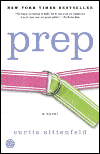
Prep’s painful pleasure

This book captures the experience of adolescence excruciatingly well. It tells the story of Lee Fiora, a student at Ault, a prep school in Massachusetts. She is from Indiana, and isn’t quite sure why she ended up at a boarding school — she had a vague desire for something different, a new experience, and the next thing she knew, she’d won a scholarship and was on her way east. The novel follows her through her four years at the school.

Lee feels like an outsider in many ways: she is on scholarship, which she desperately hopes no one will find out, although she knows very well that there are no secrets at Ault. She didn’t grow up with money and is a bit bewildered by those who did. She is confused by the east coast culture that feels colder and warier than what she is used to. She’s not part of the “cool” crowd; in fact, she has trouble making any friends at all. Most of all, she feels awkward everywhere, unsure of how to talk to people and whether to talk to people and desperately afraid of doing the wrong thing and drawing attention to herself.

Lee is an acute observer, and the story is told in first person from her perspective, so her insights into what she experiences make up one of the chief pleasures of the novel. She strikes me as very smart, but she doesn’t do particularly well in her classes; rather, her intelligence shows itself in her ability to understand the minute details of social interactions and to analyze people’s feelings and motivations. Here is what she says about how she relates to people:

I often messed up with people, it was true, but it rarely happened because I was reading them wrong; it was because I got nervous, or because I could see too clearly that I was not what they wanted. And, in fact, it was in falling short that I truly excelled. I might fail to be what that other person sought, but as a failure, I’d accomodate them completely.


She is a careful researcher of the school; we see her reading through past yearbooks and current school directories to glean all the information she can about the students and the school culture. She doesn’t expect that others might do the same, however. When she meets Conchita, a fellow student she befriends briefly, she is surprised that Conchita has done her research too:

Certainly, I had ideas about other people, but Conchita was the first person I’d encountered who seemed to have ideas about me. Besides, in spite of my zest for gathering information about other students, I would never have revealed what I’d learned to the people whom it concerned; I knew enough to know that if, say, over dinner you said to some guy you’d never spoken to before, Yeah, you have a sister who went to Ault, too, right? Alice? Who graduated in 1983? It would only creep him out.


Lee feels invisible at Ault. She puts together as complete a picture of the school as she can, but she’s not sure of her place in that picture and doesn’t have the confidence to carve out a spot for herself.

And this is the painful part — Lee’s descriptions of high school are so accurate, it frequently made me wince. The social rules are so strict and the penalties for violating them so severe, that Lee feels paralyzed. One of the worst moments is when Lee’s parents visit for Parents’ Weekend. Lee is happy to see them — she is living an 18 hour drive from home after all — but the visit quickly turns ugly as her parents inevitably say and do exactly the wrong thing and Lee, in her agonizing self-consciousness, gets irritable and angry. I felt sympathy for Lee who is trying to navigate her way through a clash of cultures — her parents who knew her as a different type of person than she has become at Ault and the school where she’s so uncertain of her place. But I also felt sympathy for her parents, who mean well, but who just can’t figure out how why Lee is so different and what she wants from them and why they embarrass her so much.

I think this book has some flaws: especially in the beginning some characters appear, you get interested in them, and then they fade away. I suppose this is a potential danger when an author is trying to cover the four years of high school with some thoroughness and accuracy. Also, the story is told by Lee in her late twenties, and while her perspective is usually that of a teenager, Sittenfeld occasionally switches into Lee’s older voice and viewpoint. This switching can feel awkward at times.

But this strikes me as minor. Lee is a wonderful character: her intelligence, wit, and honesty keep her self-pity from getting annoying. And her insights into school culture, social dynamics, and relationships make the experience of reliving one’s adolescence as one reads a pleasure.

2 Comments

Filed under Books, Fiction

How do we read

Litlove has a recent post on “ethical criticism,” a term taken from Wayne Booth, which refers to reading and judging books based on their ethical stances. Litlove writes about the difficulty of figuring out what to do with books that express something ethically troubling — for example Huck Finn, and the way one can label it racist — or not — and Camus’s The Outsider and its story of the casual killing of an Arab man. So, the question becomes, how do we read these books? DO we read them? How should we write about them? How do we handle them when we can’t come to a consensus about them?

I don’t have any great answers to these questions, other than to say that I don’t think anyone should discourage anybody from reading anything because of ethically dubious content. But that doesn’t mean those ethical problems aren’t up for discussion and critique. When it comes to course syllabi, it’s a bit more complicated because a syllabus by its nature excludes, and so it becomes easier to keep replace something troublesome with a text more pleasing to contemporary readers. But I think the classroom is a great place to read books that challenge our sense of ethics — to consider the ways Huck Finn might or might not be racist. These books should be part of a debate, not excluded from it.

This discussion reminds me of a conversation I had with a graduate school professor with whom I took a couple classes in contemporary American poetry. I had a talk with her in her office one time about poetry, and I don’t remember the full context, but I mentioned liking Robert Lowell, and I remember that she gave me a funny look. The look was unintentional, I’m sure, and probably she wasn’t even aware of it, but it seemed to me to express disapproval of my poetic tastes. It said something like, “oh, you poor thing, why do you like that poet? He treated women so badly! He owes a huge debt to Anne Sexton he never acknowledged, and he stole material from his wife to use in his own poems. If you thought about it more, you’d decide you don’t like Lowell after all.” She didn’t say anything, but the look was enough to make me realize she was judging me — probably thinking I was a naive reader, a victim of the patriarchy that made me read texts and authors that belittle women all my life.

Now that might actually be true — I might have been a naive reader, and I certainly had had to read texts that portray women badly all my life — but why should anyone judge me for getting something valuable out of those texts anyway? Why can’t I like Lowell? I think it is important to consider the ways Lowell might have written about women badly — I don’t want to be a naive reader after all, if I can help it — but that, in my opinion, doesn’t mean I can’t read him or appreciate what he does in his poems.

I’ll bet this professor wasn’t really aware of what she was communicating to me, and on some level I was highly sensitive about the issue, or I wouldn’t have read so much into such a short exchange. But I wish she hadn’t been so quick to judge me. There are all kinds of reasons to read people with whom we might disagree, or who might offend us in some way. I might decide that the bad outweighs the good in a particular author and conclude that I don’t want to read that person anymore, but I wouldn’t want to impose that personal decision on anybody else. Wayne Booth’s ethical criticism sounds valuable; I think it’s important to consider the moral world created by a work of art, but I think an ethical criticism that sets out to keep people from reading something or that makes judgments about people’s pleasure in reading something just isn’t worth it.

Leave a comment

Filed under Books, Reading

Saturday randomness

  • I had my first in-person book club meeting yesterday, and my first online one as well, and both turned out to be fun. For the in-person one, we discussed Ann Tyler’s book Digging to America. There were four of us, so it was small and comfortable, and the discussion was good; we had some interesting disagreements, nice ones, to keep things lively. We plan on meeting again in a month or so and reading John Updike’s new novel Terrorist. The discussion for the online book group, the Slaves of Golconda, is ongoing over at Metaxu Cafe.
  • Yesterday, while I was waiting for the pizza I’d ordererd to be ready, I wandered into the one used bookstore in town I hadn’t yet visited. I’m embarrassed at how long it took me to get there — I live in a small town with a surprisingly large number of used bookstores, four, and I guess I was satisfied with the other three. But now I’ve checked it out, and it’s small, with a specialty in history books which I tend not to read that much, but it has some good fiction shelves as well. I came across two Elizabeth Taylor books, In a Summer Season and The Sleeping Beauty. I’d only heard of Taylor recently, on blogs, and she seems like someone I should check out.
  • I joined the Proust reading group. The group blog is Involuntary Memory; if anyone is interested in joining, let Stefanie know — she’s the organizer, and I’m sure she’d love it if you joined. I’ve never read Proust before, beyond perhaps a quotation here and there, so I’m excited. The people I know who’ve read Proust — okay, two of them — enjoyed it but struggled a bit too. One of these people is still slowly working his way through the novel, I think, although he may have abandoned it. So my impression is that I’ve gotten myself into something big. But I love big reading goals, and I like very much the idea of doing this with a group, for the deadlines and for the discussion. It looks like we’ll be reading at the pace of 50-60 pages a week, which is manageable for me.
  • But in order to get ready for Proust, I want to finish the big novel I’m in the middle of right now: The Tale of Genji. It’s almost 1,100 pages, and I’ve got about 400 left. I’m enjoying it, but … you know that feeling when you get 2/3 or 3/4 of the way through something and you start to get anxious because you’re ready to finish it and move on to something else? I’m in that mode right now. So I should dedicate this weekend to finishing it, and by that time my Proust volumes should have arrived in the mail.
  • I’m also itching to finish my nonfiction read, Privacy, and move on. It’s a really interesting cultural and literary history of privacy in the 18C, but again, I’m ready for something else. I’ll be reading a biography of Olaudah Equiano next which I’ll be reviewing for a journal, and then I think I’ll pick up Elaine Scarry’s On Beauty and Being Just.
  • Last but not least — I’m on vacation until July 10th. I’ll be home, and posting regularly, but I’ll be lounging around, reading, and riding my bike and not thinking about work at all. Yippee!

Leave a comment

Filed under Books